
- Home
- About Us
- Roll of Honour
- Unit History
- Regimental Records
- Page Turning Ceremony
- Soldiers of Oxfordshire
- 142 (QOOH) Veh Sqn RLC
- Churchill’s Funeral
- Liberation of Belsen
- Oxfordshire Blue Plaque
- WW2 & 63 (Oxf Yeo) A/Tank Regt RA TA
- 251(OY) Bty & 85th Anti-Tank Regt, RA
- Clippings
- Useful Links
- Our Cookie Policy
- Our Privacy Policy
Into Battle
This second page covers the battles in Malaya and finally the attempted fight to save Singapore. Sadly, the Regiment (plus many of the troops arriving with the 85th) were untrained for the conflicts they now faced. They had no experience of jungle warfare, and were expected to step into the fray almost immediately upon disembarkation, following a 2-month sea voyage. They’d had no time to acclimatize to their new environment. Also, their vehicles and guns had the incorrect camouflage-paint for the location they now found themselves in.
They were also up against an enemy who had been fighting since 1937, capturing Korea, much of China and led by Elite Guards regiments. They had come through the ‘impenetrable jungle’ as if they had been walking across a beach. They had travelled 600 miles in seventy days, a lot of it on bicycles..
Singapore’s latitude is 1.2 ° north of the equator, and has a tropical rainforest climate with a wetter monsoon season from November to February… Whereas Britian has a latitude of around 50° N, and doesn’t experience the heat and humidity of Singapore.
If you can read this, thank a teacher. If you are reading it in English, thank a veteran.
Into Battle
251 Battery
After a few days the Regiment was in receipt of some of its equipment. Parts of the Regiment, including 251 Bty, then saw action against the advancing Japanese forces. They were sent north, into the jungles of Malaya, as independent units to assist the infantry already fighting against the Japanese army. Accounts of these actions are sparce, but some commenting that they hadn’t trained for ‘jungle-warfare’ and their 2pdr guns not suitable for the terrain they found themselves in, not to mention their colour of ‘dessert sand’ for the Basra operations planned for them previously.
BSM Ben Pritchett of 251 Bty records: “A few days later we were hurriedly moved up into Malaya, and went ‘into action’ alongside the Ghurkhas. We got up as far as Potian Kechi.” [Potian Kechi (Potian Kecil) was located on the west coast of Malaya, some 20km west of Johore Bahru]
A further account which backs up BSM Pritchett’s report – A young subaltern (2/Lt Jack Osbourn, F Tp, 251 Bty) had been ordered to take his Troop of 4 guns up the west coast road of Malaya and rendezvous with a Brigadier. They never arrived due to encountering the Japanese forces. They then began their withdraw back to Singapore, meeting on their way, a number of Ghurkhas and Lt-Col Toosey (of “Bridge on the River Kwai” fame), who had lost contact with all but one troop of his own guns (135 Fd Regt). Together, these three officers [Lt-Col Toosey, Capt Wiley (leading the Gurkhas) and Osbourn] had worked out a plan to get them all back to Singapore. Toosey had worked out the Japanese tactics [when they came upon Allied troops, they engaged them with small-arms fire; then they ordered up artillery fire, at which point their infantry broke off and did a ‘Japanese hook’, going around through the jungle and down the coast in small boats (of which they had plenty); they then came up behind to fire on the troops they had pinned down]. Toosey told Osbourn; “We will fight them as a unit. Every time we’re attacked by small-arms fire, Wiley (with his Gurkhas) will engage them, and you and I will start the retreat to meet them again head on when they start their hook”. In this way Toosey, Wiley and Osbourn fought their way back to the Causeway (which leads to the island of Singapore), encountering the enemy several times.
At a time and in conditions in which the Allied troops were being outmanoeuvred and out fought, theirs was a well-ordered operation, but still a retreat.
This last account came from Maj John Turrill (Bty Cmdr), 251 Bty – “Within three days of arrival in Malaya elements of the Battery were in action on the west-coast road of Johore on the Malayan mainland, south of Batu Pahat – ‘E’ Troop (Lt J Hatchett). Only two Batteries of 85th AT Regt were involved in this part of the campaign and after the other Battery [possibly 270 Bty] lost some guns, 251 Bty was the only AT defence on the west coast, for the last 40 miles of ‘tip and run’ action. Successive stands against the Japanese were at Banut (E Troop), Pontian Besar (F Troop – Lt HJL Osbourn) – 20 milestone (D Troop – Lt G Carpenter) and the 15 milestone.”
“In this part of the campaign the Battery was supporting the Gurkha Brigade of 11th Indian Division. Apart from the AT Guns on the Causeway perimeter, the Battery was the last artillery unit off the mainland onto Singapore Island.”

270 Battery
270 Bty also saw action on the mainland. Stuart Young, in his book “Life on the Death Railway”, alludes to the delays in unloading the AT guns and equipment: “The front line was nearing Johore when sufficient guns and equipment were at last brought ashore to equip one Troop of four guns and send them into action. They set up their positions and prepared for battle, only to find that they were completely surrounded and cut off. Nothing for it but to destroy the guns and transport and to take to the jungle to find a way round. Eventually, dirty, tired and ragged, they reach the coast, where they were picked up by a naval patrol boat and returned to Singapore”.
On 23rd January, Maj TW Moore of 270 Bty recorded in his diary: “H Troop (under comd 2/Lt RM Nesfield) proceeded to act as an infantry platoon to the northern end of the Causeway”, suggesting that by this time the battery may still have been awaiting their AT guns and vehicles.
Moore’s entry for 28th January, some 5 days later, details 270 Bty’s first full deployment on mainland Malaya: “Battery took up positions in the area of Johore Bahru as under, forming part of ‘X Force’, under command of 54th Infantry Brigade:
G Troop – area, South Coast Road, English School, and adjoining roads – In support of 2nd Gordons.
H Troop – area, Johore Civil Service club, Waterworks – In support of 2nd Gordons and AIF.
I Troop – area, Waterworks, Johore/Ayer Hitam Road – In support 20th AIF”
The tasking was short lived; three days later, on 31st January, with the rest of the British Forces, Moore’s men were to move off the mainland and withdrew to Singapore.
281 Battery
Gunner Stan Rowling also notes in his memoirs, this first action of 281 Bty on mainland Malaya: “After a few days at Birdwood Camp we went over the Causeway to Johore Bahru. Our battery then went up the Mersing Road [towards the east coast], from there we had to keep retreating until we ended up just outside Johore Bahru. Next, we took up a gun position in a rubber plantation. From this position we watched troops and transport retreat over the Causeway, and later learned our detail was ‘Operation Rearguard’ led by Lt Orton, K Tp, 281 Bty, 85th AT Regt”.
45 Battery
The role and movements during the last two weeks of January 1942 of 45 Bty are, at the time of writing, very little. On 19/1/42, one Troop had been allocated to the 3rd Indian Corps. Under Lt Yeoman, with Lt Sauvage, they found themselves on 20/1/42 at Yong Penn, Batu Pahat District, some 60-70 km NW of Pontian Kechil, where they had been attacked by Japanese planes but had engaged some enemy tanks before retreating. On 26/1/42, Sgt James Hawes of 45 Bty became the Regiments first casualty, being Killed-in-Action at Rengit, Johore, some 40 km NW of Pontian Kechil.
Another report found, which may have something to do with the above – ‘As might be expected, Percival’s personal interest seemed to have unblocked things; one Troop (of 4 guns) was sent to 3rd Indian Corps just a few hours later, at 6pm on 19th January, with the rest of the Battery (two more Troops) promised for the following day.’ However, at 2.30pm the following day, 20th January, the Adjutant of the 85th AT Regt advised that this looked unlikely, adding the comment “They have unloaded nothing since mid-day. Brigade Comd is going to HQ 3 Indian Corps today and will explain the position”.
RHQ
Stuart Young records a move south from the 85th AT’s initial billet at Birdwood Camp, which was to the southeast of the Sembawang naval base, “to positions in the rubber, already occupied by the Manchester’s” who were being held in reserve to defend Singapore. He then moved to Paya Lebar, 8km west of Changi and a similar distance northeast of Singapore town, probably still with the Manchester’s. He notes that sufficient of the 85th AT Regt’s equipment had by then been received to send “several more troops up country”, suggesting this move probably happened in the last week of January, in the final days before the fall of Johore.
Withdrawal from the mainland
Local Orders were sent to all the British forces to withdraw to the island of Singapore, in the hope that battle-lines could be made to hold the Japanese onslaught. Many detached units of the 85th AT Regt fought at various locations on the island before withdrawing into the built-up areas of Singapore. The Japanese had air superiority, with continual bombing raids.
In anticipation of the fall of Johore to the Imperial Japanese Army (IJA), a ‘Withdrawal Plan’, across the Causeway to Singapore, had been prepared and was distributed on 24th January. A bridgehead force, commanded by 3rd Indian Corps, was to protect the approaches to the Causeway whilst the Allied Forces would rapidly withdraw through this bridgehead.
The bridgehead force comprised of 122 Fd Regt RA, equipped with 25pdr guns, the 2nd Bn the Gordon Highlanders, a composite Australian unit (in battalion strength), a Machine Gun Company (assumed from the 1st Manchester’s), and an ‘Anti-Tank sub unit’. The 3rd Indian Corps were to ensure construction of A/Tank blocks on all the roads traversing the bridgehead position and to ensure A/Tank defence in depth. There were four A/Tank regiments at Singapore [80th, 85th, 125th, and 2/4th (Australian)]. But it is now believed that soldiers led by Lt Orton, K Tp, 281 Bty, 85th AT Regt had been used at the bridgehead (Operation Rearguard).
The decision to evacuate the mainland was finally made on 28th January 1942, at a conference organised by Gen Percival, with the timing set as the night of 30th/31st January. The Causeway had been mined with naval depth charges which would be detonated as the final step in the evacuation.
Stan Rowling of 281 Bty, 85th AT Regt records his role in the operation: “We received orders to move and went to the Sulton of Johore’s Police Barracks, where the police force had disbanded and gone, leaving everything behind. We stayed there for the night, and could see all the oil tanks at the naval base were on fire. Next day we assembled at the causeway, then went across in lorries, without incident, led by Lt Orton (K Troop).”
The last of the Australian troops left the mainland around 7am, accompanied by the Gordon Highlanders and followed by the Argylls, led by two pipers. At 8am the explosives (depth charges that had been buried on the Causeway) were detonated resulting in a 70 ft gap in the Causeway, although at low-tide the gap had a depth of only 4 feet.
Gen Percival summarised the final withdrawal to Singapore Island, 27th – 31st January 1942, in his despatch: “The final withdrawal on the night 30-31 January was carried out without incident and little interference from the enemy’s Air Force. At 08:15 hrs 31st January, all troops had been withdrawn and a gap of 70 feet was blown in the Causeway. The operation of withdrawing the whole force through the bottleneck of Johore Bahru and over the Causeway, with the enemy holding complete control in the air, had been an anxious one. In spite of severe losses which we had suffered on the mainland, the successful accomplishment of this operation was a matter for much satisfaction.”
Destroying the Causeway was designed to prevent the Japanese from bringing its infantry, artillery and tanks onto Singapore island; in practice it only served to slightly delay the inevitable, with the surrender of Singapore coming just over two weeks later. The fall of Johore released food and provisions to the Japanese, who by now had a severely extended supply chain and were running low on supplies.
Records held by ‘ELTZ’ show only one death up to this time, that of W/Sgt JR Hawes of 45 Bty – “Killed in Action, Johore Rengit, 26th January 1942″
Defence of Singapore Island
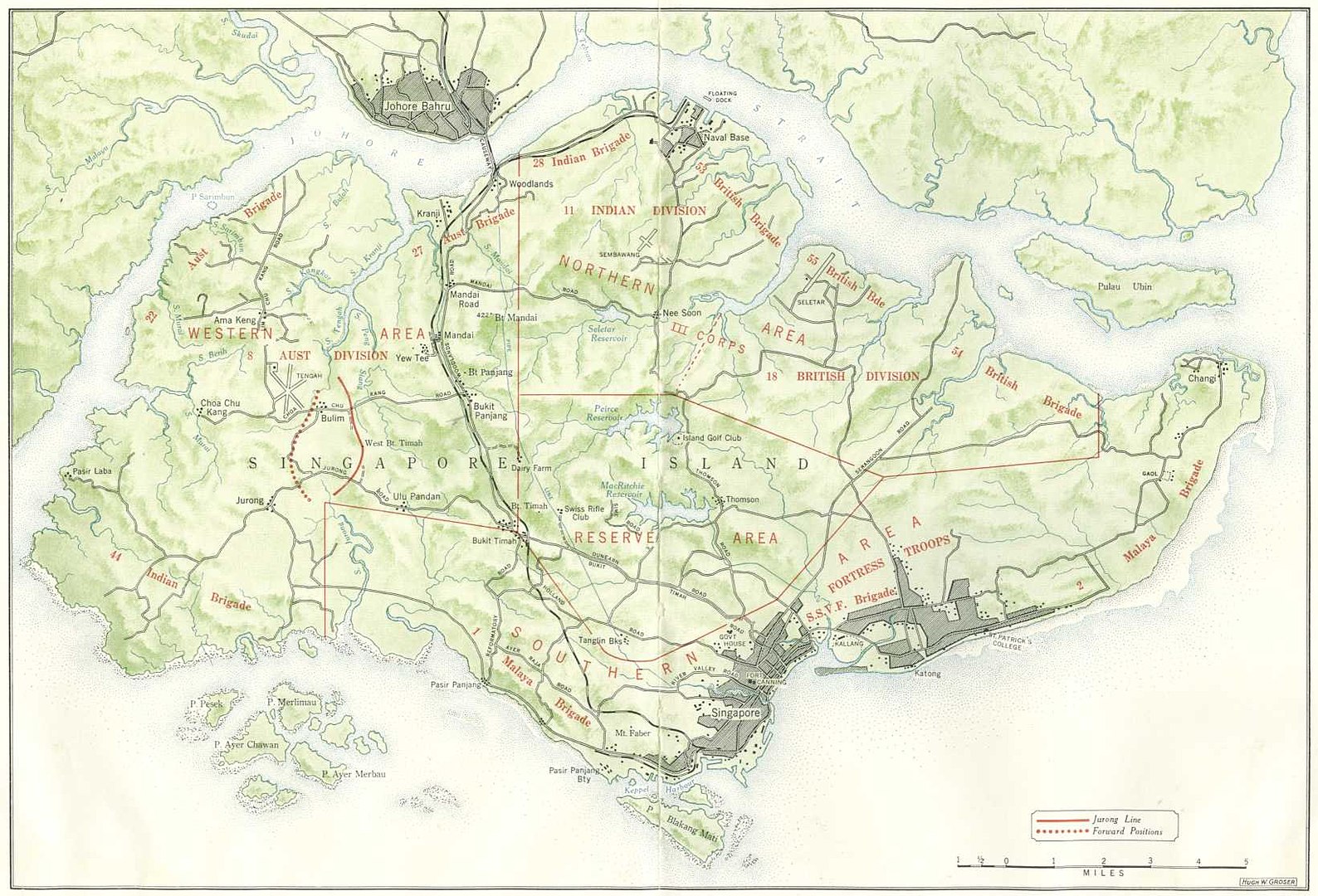
On the north-eastern coast of the island, roughly midway between Kranji and Changi, lay Seletar Airfield, in the area defended by the British 55th Brigade, including the Cambridgeshire Regiment. Jon Cooper’s book records that “elements of the 85th AT Regt” were assigned to assist C Coy of the 1st Cambridgeshire’s in the defence of the airfield during the period 31st January to 9th February 1941. These “elements” may have included 281 Bty, 85th AT Regt. Stan Rowling of 281 Bty recalls this period: “Then we were sent with our gun to a position by a creek, at the back of Seletar Airfield. Infantry and Ghurkhas were here. We dug a gun-pit, installed our gun, and remained here till further orders. A fifth-columnist had climbed a coconut palm, tied a black flag at the top, to give our position away to the Japs. Another ploy was to place white washing on the ground in the shape of an arrow, which was easily seen from the air, it pointed towards our troops. We saw our troops wading and swimming across the creek, to escape the Japs, next thing, the infantry who had been there, had gone and only our gun crew remained”.
In documents retrieved from the National Archives state that the 85th were tasked, initially, to cover three main roads of Seletar, Sarangoon and Tampines leading to the NE of the island, leaving two Troops as a mobile Division Reserve. This was later changed and some guns were sited on the beaches overlooking the Johore Straits. This was the Northern Area sector of the Defence Plan. In these same documents it states that 45 Bty had been helping to defend Seletar. Eventually, all four Batteries of the 85th found themselves spread across this area of shoreline of the Johore Strait on the north eastern flank between Seletar airfield and the Serangoon river.
On 6/2/42, the 85th suffers its 2nd casualty when L/Bdr Garside of 270 Bty was Killed-in-Action at Punggol Point, near Seletar by mortar shelling from across the Straits of Johore. ELTZ are in possession of differing reports of L/Bdr Garside’s death – one is of the above account; the other states that Garside received shrapnel wounds at Punggol Point and died in Changi Hospital on the same day.
In his account of actions at Singapore, Maj J Turrill (251 Bty BC) relates the following – “In the final campaign for Singapore, which began at the end of the first week in February 1942, the Battery was split between brigades of the 18th Division which had just reached the island and various composite forces formed for special tasks. In an untidy and apparently uncoordinated defence of the island the simplest way of describing the Bty’s efforts is to say that even though it was largely deployed across the axis of the main Japanese thrust at Singapore City, no Japanese tank got through in any sector which was our responsibility. At one critical time the most forward troops in the line of the Japanese attack down the Bukit Timah Road were E Troop. In confused fighting on Feb 14th just north of the Bukit Timah Road, some guns of D Troop were involved in hand-to-hand fighting with Japanese infantry when our supporting infantry company were forced to withdraw. One gun (Sgt Harry Salter, D Tp) engaged the enemy in a house [in Mt Pleasant Rd] at point blank and the situation was restored. Sgt Salter was awarded an immediate DCM. Two other members of the Battery were recommended for awards as a result of this action [L/Bdr Quigley & Gnr Massey].”
Sgt Salter’s recommendation for his DCM quotes “At dawn of Sunday 15th Feb 42, D Tp, 251 Bty were taking up position in support of 4 Suffolks. Whilst leading his gun into position he was suddenly attacked by a party of enemy on his left. On his own initiative he moved his gun into a better position to engage the enemy infantry, this was under heavy m/gun fire and sniping from trees close by. He ordered the remainder of his detachment to take up firing positions and engage with small-arms fire. As the fight continued it was apparent that a nearby house held enemy m/guns and snipers. On his own initiative he returned to his gun and without assistance loaded and fired six rounds into the house which caused the enemy to cease firing temporarily. The gun was now engaged by enemy mortars and after one of his men had been wounded, he temporarily removed it. Later at 12.00 the 4 Suffolks identified another house in Mt Pleasant Rd which was occupied by the Japanese, causing considerable casualties amongst the infantry and unable to drive them out. Sgt Salter was ordered to engage this house. Showing coolness and disregard of his own safety, wheeled his gun to within 40 yds of the house under point blank gun-fire from it. Under heavy m/gun fire he continued to fire at the house until the m/guns were silenced and the house burst into flames, causing the enemy to run out the back where they were met and shot by the 4 Suffolks. The situation was cleared and the road re-opened for movement of troops. On the previous day Sgt Salter’s gun had destroyed an enemy tank in the face of heavy enemy fire on the Bukit Timah Rd.”
Creation of ‘Tomforce’
With the risk of the Japanese breaking through the Kranji-Jurong line, Gen Percival clearly needed to strengthen the defences around Singapore City, and at Gen Wavell’s initiative, had asked Sir Lewis Heath, commander of the 3rd Indian Corps (five Brigades, of which three were by this stage UK British), to form a scratch Brigade under the command of Lionel Thomas of the Northumberland Fusiliers, hence known as “Tomforce”. Smith records that Tomforce comprised of the 4th Norfolk’s, from 54th Brigade; the 1st and 5th Sherwood Foresters, from 55th Brigade; the 18th Reconnaissance Corps; and a Battery from the 85th Anti-Tank. This would appear to have been a composite battery made up of H Tp, 270 Bty; C Tp, 45 Bty; and D Tp, 251 Bty. Maj Moore, commander of 270 Bty, records that on 9th February: “H Troop left the Battery to join a ‘Composite Battery’, area of Bukit Timah road; this Battery formed part of the force known as ‘Tomforce’.“
It seems that with the Japanese assault on Bukit Timah, and the main thrust coming down through the middle of the island a great many of the Allied forces were being dragged back to oppose this thrust, this began soon after sundown on 10th February. Maj Moore records the role of G and I Troops (parts of his 270 Bty) of the 85th AT Regt on this day as they were deployed to defend the city: “270 Bty (less H Troop) evacuated present location, taking up positions on ‘Singapore Perimeter’, under command of 55th Inf Brigade. G Tp – are of Mount Pleasant Rd – Thomson Rd; I Tp – area of Police Station, Singapore – ½ mile along Thomson Rd; BHQ’s – area of Mandalay Rd, Singapore.” Moore also includes a handwritten note that by this time “the Battery had under command two Troops from other Batteries, C Tp (from 45 Bty) and D Tp (from 251 Bty).”
Elements of the 85th had found themselves all over the island of Singapore, at Thomson Village, Bukit Timah, Fort Canning to mention a few, but drawing ever closer to the built-up areas of Singapore City
The number of casualties begin to climb also, and adding to the previous two deaths, the following men were either killed-in-Action, Died of wounds or Missing believed killed :-
7/2/42 – A/L/Sgt R Little (45 Bty) – D of wounds, at Tanglin Hospital, Singapore
11/2/42 – A/L/Bdr D Chattaway (45 Bty) – KIA, at Singapore Race Course, Bukit Timah
12/2/42 – A/L/Sgt JT Richardson (45 Bty) – KIA, at Bukit Timah Rd, Singapore
15/2/42 – Gnr R Bird (RHQ) – D of wounds, at Mandalay Road, Singapore
15/2/42 – Gnr RL Busby (251 Bty) – KIA, at Thompson Road, Singapore
15/2/42 – Gnr BL Challis (RHQ) – KIA, by shellfire, Mandalay Road, Singapore
15/2/42 – Gnr C Chapman (270 Bty) – KIA, at Thompson Road, Singapore
15/2/42 – A/Sgt EJ Claydon (251 Bty) – KIA, by air raid bomb, Fort Canning, Singapore
15/2/42 – W/Sgt G Cross (251 Bty) – KIA, by air raid bomb, Fort Canning, Singapore
15/2/42 – A/Bdr J Gee (251 Bty) – KIA, by air raid bomb, Fort Canning, Singapore
15/2/42 – Gnr JG Jones (270 Bty) – KIA, at Thompson Road, Singapore
15/2/42 – Gnr SW Taylor (251 Bty) – D of wounds, at Fort Canning, Singapore
15/2/42 – A/Sgt RR Trace (45 Bty) – Missing, believe killed, at McRitchie Reservoir
15/2/42 – Gnr FG Westwood (270 Bty) – KIA, at Thomson Road, Singapore
15/2/42 – Gnr AE Wilson (270 Bty) – Missing, believed Killed in Singapore
15/2/42 – Gnr GA Worton (270 Bty) – KIA, at Thompson Road, Singapore
It is known that two officers (Capt RCB Greville & Lt JJ Hatchett) and two ORs (Gnr’s WJ Pitches & FR Scates) all of 251 Bty had tried to make an attempt of escape following the decision of capitulation. Sadly, they were never heard of again so it’s assumed that they died whilst attempting escape but not known where. What is known is that all four were last seen on Halifax Road, Singapore at 16.00hrs, 15/2/42. Capt Greville and Lt Hatchett had acquired a lorry and found extra fuel, and planned to break out along the Causeway and try to get to Burma. It is also known that they spoke with others to see if they were interested in joining them. What is not known – did they try escaping together ?
RASC Section att to 85th
There is not a lot of information available regarding the activities of the RASC Section during the time of the attempts to hold back the advancing Japanese forces. We know of a few deaths during this time of the defence of Singapore Island (1st-15th Feb 1942), but that doesn’t mean that the RASC had not played their part, just that they had been luckier.
The first recorded deaths came on 7/2/42 when two were killed (Pte W Haynes & Pte JH Swinglehurst) and another wounded during a bombing raid on Changi. Next, were two more who had been reported missing (and never found) on 13/2/42 (Dvr JB Mercer & Dvr JH Wright), they had last been seen driving a lorry loaded with ammunition in Beach Rd, Singapore. And then on 14/2/42, a fifth RASC man (Dvr LB Manning) is believed to have died of wounds at Tanglin Hospital, Singapore.
It is believed that this RASC Section had found a ‘home’ at Tyersall Park, Singapore; as on 14th February a roll-call was called accounting for a lot of the men of this Section.
Sadly, there were more deaths to come, in the years following, during captivity.
The fall of Singapore
With water supplies hit, vehicle fuel and artillery ammunition almost non-existent, the decision was made to surrender, in an attempt to protect the civilians in the city of Singapore. The peacetime population had been estimated at around 770,000, but when registration was carried out (in preparation for food rationing), the figure was found to be around 900,000. In addition, the island now also housed close to 100,000 British, Australian and Indian troops. Singapore was now reliant on the supplies it had on the island – not just in terms of food, but also water. Three large storage reservoirs in the middle of the island were fed by a pipeline from Johore, running across the Causeway. The latter of course was no longer available, and thus the water supply was a critical weakness.
During this period of around 30 days before their surrender, the 85th AT Regt lost nineteen men who were killed in action or died of wounds (four from 45 Bty; five from 251 Bty; five from 270 Bty; two from RHQ: and three from the RASC Section) with eight more reported missing in action, or believed to have been killed whilst attempting to escape, following the decision to surrender (one from 45 Bty; four from 251 Bty; one from 270 Bty; and two from the RASC Section). This made a total of lives lost before coming POWs of 27 officers and men.
At dusk on 15/2/1942 Singapore falls, with hostilities ceased as of 20.30 hrs, and the Regiment are taken into Japanese captivity.
This ends the period of the 85th AT Regt’s (along with many other Allied units) attempt to hold the Japanese advancement. Sadly, through no fault of their own, they failed with the inevitable ending.
When you go home, tell them of us and say, For your tomorrow, we gave our today.
John Maxwell Edmonds
Now go to the next page [Captivity] to read of the Regiment’s treatment at the hands of their captors. There are mentions of further escape attempts, acts of bravery, of resistance and sabotage.
- Home
- About Us
- Roll of Honour
- Unit History
- Regimental Records
- Page Turning Ceremony
- Soldiers of Oxfordshire
- 142 (QOOH) Veh Sqn RLC
- Churchill’s Funeral
- Liberation of Belsen
- Oxfordshire Blue Plaque
- WW2 & 63 (Oxf Yeo) A/Tank Regt RA TA
- 251(OY) Bty & 85th Anti-Tank Regt, RA
- Clippings
- Useful Links
- Our Cookie Policy
- Our Privacy Policy
© qooh.org.uk 2019-2024 All rights reserved
Designed & written by Mick Luxford with help from LCN Hosting and WordPress.org